

This story was originally published by Chalkbeat.
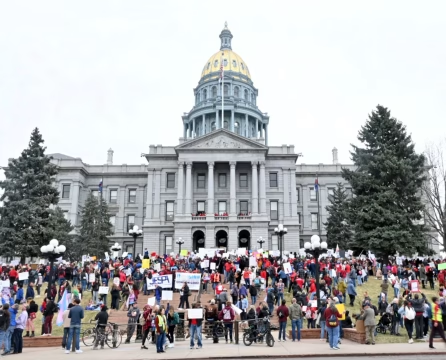
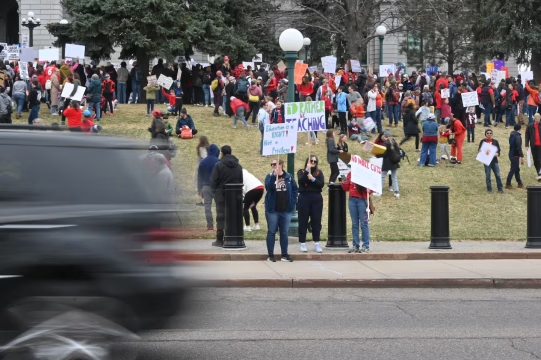
DENVER | Jennifer Pitts stood on the sidewalk near the Colorado Capitol steps on Thursday holding a sign that read “I’d rather be teaching” as cars drove by and honked in support.
Pitts, a Thornton Elementary fifth-grade teacher, said she felt it necessary to rally with thousands of other educators to call on state lawmakers to make good on their promise to fund education at levels promised last year and ensure students across the state get the education they deserve.
Several school districts cancelled classes for the day because of the number of teachers who called off work, including a partial Denver Public Schools closure and full cancellation of classes in Aurora Public Schools, Adams 12 Five Star Schools, and Boulder Valley School District
“I don’t want to be here,” said Pitts, whose school is part of Adams 12. “I really would rather be teaching. But it’s so important to be here for the kids. That’s the only reason why any of us go into this job.”
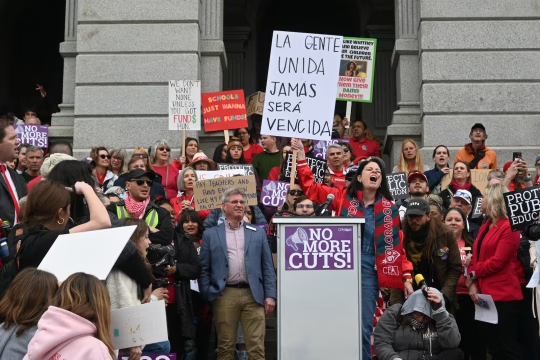
Educators from across the state gathered at the rally organized by the Colorado Education Association, the state’s largest teachers union, to protest lawmakers’ proposals that would back out of a school funding deal made last year.
The state is facing a $1.2 billion budget shortfall. Last year, state lawmakers adopted a new school funding formula that calls for an additional $500 million investment in K-12 schools over the next six years. Lawmakers now want to invest less next year than originally promised.
For too long, teachers at the rally said, the state has balanced the budget on the backs of students and educators. For almost 15 years — before lawmakers did away with what’s known as the budget stabilization factor in this year’s budget — lawmakers pulled constitutionally mandated funding away from schools for other priorities.
The choices lawmakers have made over the years have led to larger class sizes, less student support, and more strain on teachers, teachers said. This year’s proposals would further hurt education, said Jamie Nied, a Leroy Drive Elementary kindergarten teacher.
She said the state has created a situation where teachers must spend thousands each year to support students. She buys students snacks, clothing, books, pencils, and more.
“We’re very underpaid and underfunded,” she said, “so why are we continuing to cut?”
Gov. Jared Polis’ proposal would increase K-12 funding by $138 million next year. But it would also change the way the state doles out per-pupil funding. Instead of funding school districts based on a four-year enrollment average, Polis wants to eliminate averaging altogether.
A one-year count of students would mean the state is not paying for students who are no longer enrolled in school. It would then use that money to pay for investments in the new formula, Polis said.
However, some school officials said the change would mean far less money for districts that have declining enrollment. That could lead districts to cut teachers or close schools, they said.
Democratic Colorado Speaker of the House Julie McCluskie also has drafted a proposal to keep the four-year average next year, but phase out averaging over several years. Her proposal would also slow the phase-in of the new school funding formula from six years to seven years and 18% of the required $500 million to 10% next year.
In an interview Wednesday, Polis said he’s open to phasing out student averaging over time, but added districts would still lose money due to declining enrollment eventually. He said a slow phase-out would only delay the inevitable and cost the state more money.
“I think from the state perspective, the moral ground is that we should fund students who are there versus students who have not been there in several years,” he said.
Horizon High School German teacher Jason Herrman said it’s unacceptable that lawmakers would go back on a deal made last year.
“It’s just very frustrating when there’s continual cuts and cuts and cuts,” he said.
Colorado Education Association President Kevin Vick said during the rally that teachers are leaving the profession because of the state’s budget decisions.
He called on lawmakers to figure out a long-term funding solution for schools that doesn’t leave the state in a continual cycle of having to cut back on what’s required or what’s promised.
“We have to stop this pattern where every year the budget feels like ‘The Hunger Games,’ pitting one part of our needs against another,” Vick said to cheers from the crowd. “We are not tribute.”
Jason Gonzales is a reporter covering higher education and the Colorado legislature. Chalkbeat Colorado partners with Open Campus on higher education coverage. Contact Jason at jgonzales@chalkbeat.org. Chalkbeat is a nonprofit news site covering educational change in public schools.
Sounds like a bunch of Coloradans need to get their property taxes sent through the roof.
At present, we support students at a rate of over $4,000 per student UNDER the national average. I know that because I wrote Upward Bound and other similar grants and we had to prove the public schools who collaborated with our college were underfunded to qualify for the program. That puts us below 80% of the nation! At the same time, student performance is up in the top 10%. Simply put, Colorado teachers are doing great for our students, but politicians who fund our schools are and have been performing poorly – and for a long time. TABOR, a GOP statute, is an awful law with no flexibility to adjust budgets. It is the bill that many point to, causing politicians to rob education at budget time. Colorado got used to hosing education to fund other projects. Colorado will pay for this through poor teacher retention (already happening) because salaries are below places like Texas where they hold the dubious distinction of being #1 in dropout rate and are a bottom performer. Again, I know; I lived there and my granddaughter went to school there. At the same time, teachers are buying supplies for their students, while being paid less than poorly performing states. We should all know that Colorado is an expensive state. Rent is through the roof! However, to be a state that looks out for the welfare and job readiness of students, we need to dedicate more funds to education. We need to pay our teachers better and ensure they have quality healthcare available. It is way past time to initiate fully funding schools. Nickle and dimeing education is, plainly speaking, horse manure. I’m 70 with no one in school. My granddaughter is in her final years at Eaglecrest in Cherry Creek District. I would gladly pay more in taxes if I knew that the funding went to schools! Polis is wrong to put this off another year! Find the money elsewhere!
Colorado has been run by Democrats for a long time. When revenues fall short, they will always make cuts to services for everyday taxpaying citizens rather than to their socialist welfare programs (now including services for illegal aliens). Education is an easy target.